









Which Ultra Fine Pitch LED Video Wall Technology Is Right for You? COB, MIP, Mini & Micro HD LED Video wall solutions PK
Click:
Practical buyer’s guide helping AV integrators and facility managers choose the optimal LED video wall technology based on use case (control room, retail, TV broadcast), budget, and performance requirements.
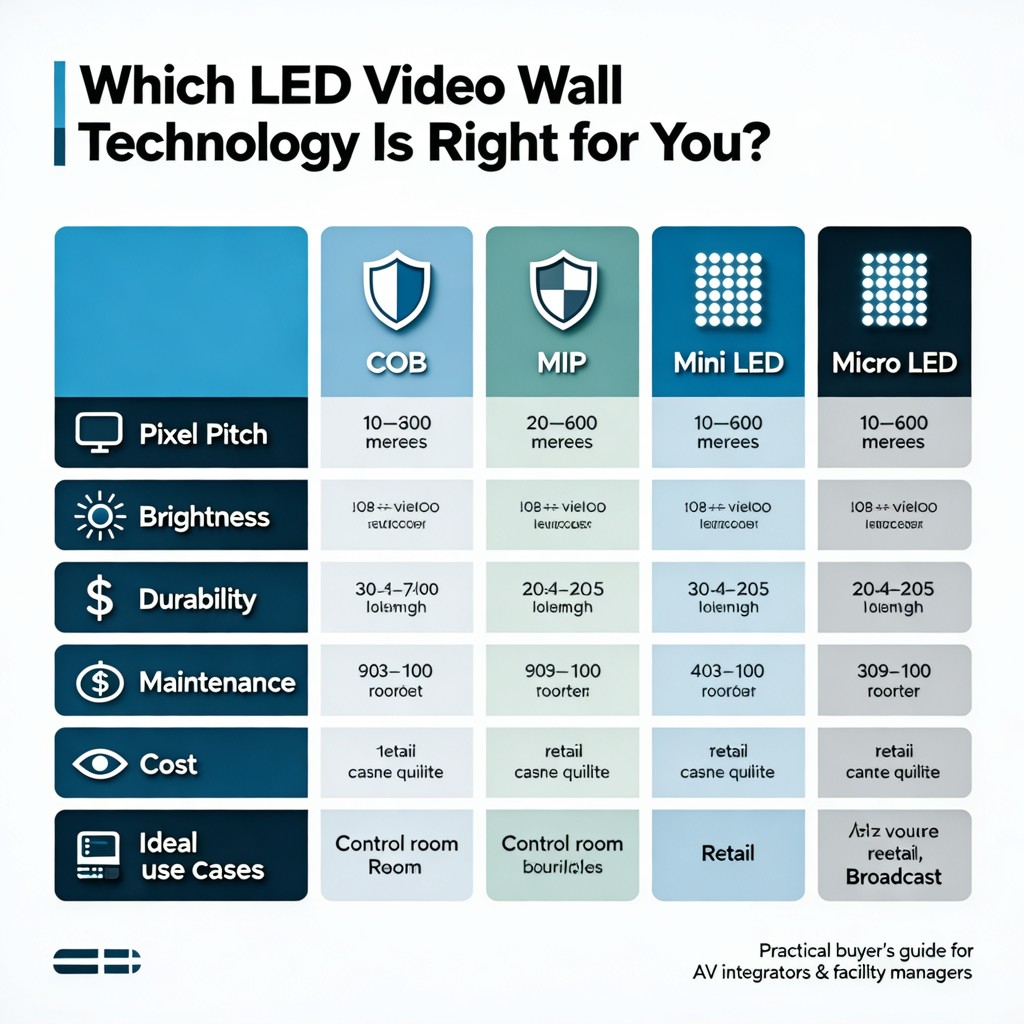
Understanding Core LED Video Wall Technologies
The Small pixel pitch LED video wall landscape has evolved significantly beyond traditional SMD (Surface-Mounted Device) solutions. Today, AV integrators and facility managers face a nuanced decision among four advanced packaging and pixel architectures: COB (Chip-on-Board), MIP (Mini LED in Package), Mini LED, and Micro LED video wall. Each offers distinct trade-offs in reliability, resolution, brightness, serviceability, and total cost of ownership—factors that must be aligned precisely with application-specific demands.
COB: Robustness for Mission-Critical Environments
COB technology bonds bare LED die directly onto the PCB substrate, then encapsulates them under a continuous layer of protective silicone or epoxy. This eliminates individual solder joints and plastic lamp housings, resulting in superior resistance to impact, dust, moisture, and thermal cycling. COB displays deliver exceptional uniformity, wide viewing angles, and high contrast—even at low brightness levels—making them ideal for 24/7 control rooms, command centers, and transportation hubs where uptime and visual clarity under variable ambient light are non-negotiable. While pixel pitch typically starts at P1.2 and scales upward, COB’s strength lies not in ultra-fine resolution but in operational resilience and long-term stability.
TEC Displays COBIT pro is the right options for COB LED video wall, 1000nits & 2500 nits applications.
- Superior Image Quality: Virtually no visible pixel gaps, excellent uniformity, high contrast, and reduced moiré effect. Great for close viewing distances.
- Durability: The resin layer protects LEDs from physical damage, dust, and liquids (some rated highly for protection).
- Anti-Glare & Better Contrast: Matte finish minimizes reflections.
- Reliability & Longevity: Improved heat management leads to fewer failures and consistent performance.
- Seamless Look: Ideal for large, bezel-free walls that look like one giant high-resolution led screen.
- HDR Support: Many models deliver vibrant colors and deep blacks.
COB ultra HD 2K, 4K, 8K video wall used below market:
- Command & control centers
- Broadcast studios & virtual production
- Corporate lobbies & conference rooms
- Retail & digital signage (high-end brand)
- Houses of worship
- Simulation & militory training facilities
- Museums & experiential installations
MIP: A Balanced Evolution of Mini LED Integration
MIP (Mini LED in Package) represents a hybrid approach: it uses mini-sized LED chips (typically 100–200 μm) housed within a compact, standardized package—similar in footprint to legacy SMD but with improved thermal management and optical consistency. Unlike bare-die COB or direct-bonded Micro LED, MIP retains modular serviceability: defective modules can be replaced without specialized tools or rework stations. It bridges performance and practicality—offering higher brightness and better HDR capability than conventional SMD, while remaining more cost-effective and scalable than true Micro LED. MIP is especially well-suited for corporate lobbies, retail digital signage, and mid-tier broadcast studios requiring consistent image quality across large surfaces without prohibitive upfront investment.
TEC Displays also offer MIP LED video wall 3500 nits to 4500 nits @ 1.2mm, 1.5mm
Mini LED vs. Micro LED: Clarifying the Distinction
“Mini LED” is often misused as a generic term—but technically, it refers to backlighting for LCD panels or, in direct-view contexts, LED walls using chips between ~50 μm and 200 μm. In contrast, Micro LED employs chips smaller than 50 μm and is defined by monolithic integration: each sub-pixel is an individually addressable, self-emissive micro-LED chip transferred onto a backplane. True Micro LED delivers unparalleled advantages: near-instant response time (<1 μs), infinite='' extreme='' brightness=''>5,000 nits), zero burn-in risk, and theoretical lifespans exceeding 100,000 hours. However, mass transfer yield challenges and complex driver IC integration keep commercial Micro LED video walls largely limited to premium broadcast studios, flagship retail experiences, and R&D-intensive environments—where budget permits multi-year ROI horizons and technical support ecosystems are mature.
Selecting the Right Technology: A Decision Matrix Framework
A structured LED display tech decision matrix helps translate requirements into actionable choices. Begin by scoring each use case across five weighted criteria: (1) Operational uptime sensitivity, (2) Required pixel density (P0.6–P2.5), (3) Ambient light conditions (e.g., sunlit retail vs. dimmed control room), (4) Service & maintenance constraints (on-site technician access, spare parts lead time), and (5) Total cost of ownership over 7 years (including power, cooling, calibration, and module replacement). For example: a financial trading floor prioritizes COB for its thermal stability and flicker-free operation under prolonged viewing; a luxury boutique may select MIP for its balance of fine pitch (P0.9), rich color gamut, and straightforward panel-level servicing; while a national broadcast network evaluating next-generation studio walls may pilot Micro LED for its color volume and seamless scalability—despite higher initial CAPEX.
Final Recommendations by Application Segment
Control rooms and emergency operations centers benefit most from COB’s durability and uniformity—especially where displays operate continuously under mixed lighting and require minimal recalibration. Retail environments—particularly those with dynamic foot traffic and seasonal content updates—favor MIP for its combination of visual impact, modularity, and predictable service economics. Broadcast facilities with rigorous color accuracy and latency requirements increasingly adopt Micro LED for primary on-air walls, while retaining MIP or high-end COB for secondary monitoring. Importantly, no single technology dominates all scenarios: interoperability with existing signal infrastructure (e.g., HDMI 2.1, SDI over fiber, NDI|HX), mounting flexibility (curved, recessed, or ceiling-suspended), and vendor-supported calibration workflows must also inform final selection alongside core display architecture.
TEC Displays will lauch new MOG Super HD 0.4mm, 0.6mm to 0.78mm

点击右上角
分享给朋友吧







 Long by picture save/share
0
Add: Block 14, Tianliao No.5 Industrial Zone, Yutang Street, Guangming Dist, Shenzhen, Guangdong, China 518132

Follow TEC
Follow TEC